Production

The Virtual Production Shift: How Real-Time Tech Is Reshaping Filmmaking

From green screens to real-time LED volumes, virtual production technologies are fundamentally changing how movies are made, shifting costs and expanding creative possibilities for filmmakers worldwide.

VR
Victor Ren

April 3, 2026 · 8 min read

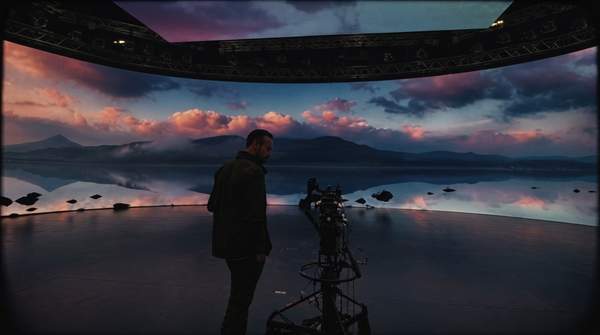
Actors performing on a virtual production set, surrounded by large LED screens displaying a vibrant alien world, with a film crew operating cameras.

Today, actors on a soundstage stand surrounded by massive LED screens displaying fantastical alien worlds in real-time, with photorealistic lighting and reflections reacting instantly to the camera's every move. This contrasts sharply with traditional filmmaking, where actors performed against green screens, reacting to tennis balls, with environments added months later in post-production. This shift from post-production compositing to in-camera final effects fundamentally transforms the production pipeline, altering budgets and creative control.

What Changed: The Real-Time Revolution

The inflection point for virtual production's widespread adoption was the convergence of two key technologies: real-time video game engines and high-resolution LED display panels. For decades, rendering complex computer-generated imagery (CGI) was a time-consuming, offline process. A single frame of a blockbuster film could take hours to render. Game engines, however, were designed to render complex 3D worlds dozens of times per second to allow for interactive gameplay. As engines like Epic Games' Unreal Engine achieved photorealistic quality, filmmakers saw an opportunity to harness this power for cinematic purposes.

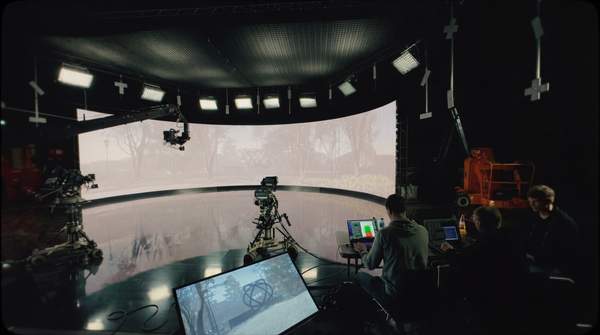
From a technical standpoint, this allowed for the development of the "LED volume" or "digital soundstage." This is an enclosed set, often curved, lined with millions of high-fidelity LED pixels. The digital environment, built in the game engine, is projected onto these walls and ceiling. A camera tracking system monitors the precise position and movement of the physical camera within the space. This tracking data is fed back into the game engine, which then adjusts the perspective of the digital background in real-time. This effect, known as parallax, is crucial for creating the illusion that the camera is moving through a real, three-dimensional space, making the technique viable for cinematic storytelling.

Virtual production collapses the once-siloed stages of pre-production, production, and post-production into a single, fluid process, allowing decisions previously locked months before filming (pre-visualization) or delayed until months after (VFX) to be made live on set. This reshaping of the industry, noted by Radical Motion, is underscored by market forecasts: the Special Effect Software Market is projected for significant growth through 2034 (Fortune Business Insights), and the Generative AI in Movies Market is projected by Vocal.media to reach USD 3,857.3 million by 2033, driven by demand for AI-assisted content creation and visual effects automation.

How Virtual Production Technologies Impact Film Budgets and Workflows

Virtual production fundamentally restructures a film's financial and logistical framework, shifting resources from traditional green screen workflows to modern LED volume shoots. This changes the nature of on-set work, moving from fixing issues in post-production to finalizing effects in-camera.

In the traditional model, a scene requiring a digital environment or a remote location would be filmed on a soundstage against a green or blue screen. The production budget would accommodate immense costs for post-production visual effects. This includes teams of artists for rotoscoping (tracing actors frame by frame), keying (removing the green screen), tracking, and compositing the digital background. On set, lighting is a complex challenge; technicians must approximate the light that the final digital environment will cast on the actors, a process that often requires digital correction later. Furthermore, if a physical location is required, budgets swell with expenses for travel, accommodations, shipping equipment, and securing permits for an entire cast and crew, all while being at the mercy of unpredictable weather.

Virtual production workflows present a different financial and creative equation: primary expenditure shifts from post-production and travel to pre-production and on-set technology.

  1. Digital Asset Creation: Before the cameras roll, VFX artists build the photorealistic 3D environment in a game engine. This is a significant upfront investment in digital "scenery."
  2. On-Set Filming: The cast performs within the LED volume. The key advantage here is that the digital environment provides the actual lighting and reflections on actors, props, and costumes. This creates a level of visual integration that is extremely difficult and costly to replicate with green screen. The director, cinematographer, and actors can see a near-final version of the shot in the monitor as it's being filmed, enabling immediate creative adjustments.
  3. In-Camera Finals: For many shots, the image captured by the camera is the final product, with the background and foreground elements already seamlessly blended. This is known as "in-camera VFX" (ICVFX). This drastically reduces the volume of shots that require intensive post-production compositing.

While initial costs for building or renting an LED volume are high, virtual production offers substantial savings. A production can "travel" from a desert to a jungle to an alien planet in a single day without leaving the studio, eliminating massive logistical costs. Environmental control allows "golden hour" lighting for a 12-hour shoot day, increasing efficiency and minimizing costly reshoots due to poor live-action/CGI integration. Variety reports these technologies streamline previsualization and reduce costs for certain effects, creating more efficient workflows.

The Shifting Landscape: Winners and Displaced Roles

The rise of virtual production creates a new ecosystem of beneficiaries while displacing established roles. This technological shift impacts technology developers, production studios, and on-the-ground crew members, redrawing the map of industry influence and required expertise.

The most immediate winners are the technology companies at the heart of the revolution. Epic Games' Unreal Engine and Unity have become central tools in the filmmaker's kit. Manufacturers of high-resolution LED panels, camera tracking systems, and powerful graphics cards have seen a surge in demand from the film and television industry. This has also given rise to a new category of specialized studios that build, operate, and rent out LED volumes. These facilities are becoming critical infrastructure, with some nations investing heavily. For instance, according to a report from CGTN, China is actively transforming its filmmaking sector through these technologies, establishing a world-leading AI virtual production base in Deqing that can generate digital worlds in real-time.

Creative professionals who adapt to the new paradigm also stand to benefit. VFX artists with skills in real-time engines are now in high demand for pre-production asset creation and on-set operation, a role that didn't exist a decade ago. Cinematographers and gaffers who learn to work with the unique properties of LED light sources can achieve unprecedented creative control. The technology also benefits productions aiming for logistical simplicity. A film can now be headquartered in one country while realistically depicting locations from all over the world, supporting a trend toward flexible, multi-territory workflows.

Conversely, some traditional sectors face significant challenges. While Variety reports that the demand for real-world environments and experienced crews remains strong, the need may become more specialized. A production might choose to capture a specific landmark on location but create the surrounding city virtually, reducing the need for extensive street closures and local support staff. This could impact location scouts, managers, and the local economies that have grown to support large-scale film shoots. Within the VFX industry, roles centered on green screen compositing may decline as more work is captured in-camera. The skill set is not obsolete, but it must evolve to incorporate real-time tools and on-set responsibilities, a transition that requires significant retraining.

The Future of Filmmaking: Virtual Production Trends and AI Integration

Virtual production's trajectory involves integration and evolution, increasingly intertwined with artificial intelligence. Film commissioners and industry insiders recognize digital soundstages and AI are transforming workflows to augment, not eliminate, traditional filmmaking. The future appears to be a hybrid model, with production techniques chosen based on specific creative and budgetary needs.

A prime example of this hybrid approach is the Dutch film "IHostage," which, as detailed by Variety, creatively combined on-location shooting in Morocco with virtual production and traditional set building in the Netherlands. This allowed the production to leverage the authenticity of a real location while using the control of a virtual set for more complex scenes. This reinforces a key insight from a film commissioner quoted in the same article: "It wasn’t a case of technology replacing location work — it was technology extending what was possible on location. That integration is, I think, where the real opportunity lies." This sentiment suggests that virtual production will become another powerful tool in the filmmaker's arsenal, used alongside, not in lieu of, established methods.

The fusion with artificial intelligence is the next major frontier. As CGTN reports, the technological push in China is reshaping its creative industries, altering how stories are imagined and produced. This includes AI-powered sets that can generate or modify digital environments on the fly. This trend is reflected in market analysis, with the growth in generative AI tools for film being a significant driver of the special effects software market. This integration signals a future where directors might use AI to generate concept art, create variations of digital sets, or even automate complex animation tasks, further streamlining the content creation pipeline. We are already seeing major players like Netflix explore this area, as detailed in our previous coverage of Netflix AI investments signaling a major film production shift.

Rapid technological advancement, particularly AI, raises palpable anxieties about its impact on creative roles across the global industry. A recent Hollywood Reporter article discussed these concerns in Chinese cinema, reflecting a worldwide conversation on balancing technological augmentation with human creativity. The industry navigates creative, ethical, and labor implications as technology provides unprecedented tools.

Key Takeaways

  • Budget Reallocation: Virtual production shifts significant costs from post-production and on-location logistics to pre-production and on-set technology. Financial benefits stem from increased efficiency, control, and reduced variables like weather and travel.
  • Hybrid Workflow Future: The trend favors flexible, hybrid pipelines, not complete replacement of traditional methods. Productions will increasingly mix on-location shooting, traditional soundstages, and virtual production volumes for optimal creative and financial outcomes.
  • New Demand for Real-Time Skills: The adapting workforce requires artists, technicians, and crew proficient in real-time game engines, 3D asset creation, and on-set virtual production operations, highlighting a critical area for training.
  • AI Integration: Virtual production's convergence with generative AI will accelerate changes, unlocking new creative possibilities and efficiencies while prompting discussions on future creative roles and intellectual property.