Virtual Production
Best for: Feature films, television series, commercials, and corporate content seeking enhanced creative control and efficiency.
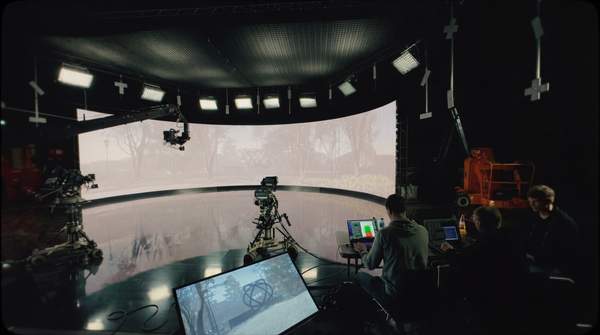
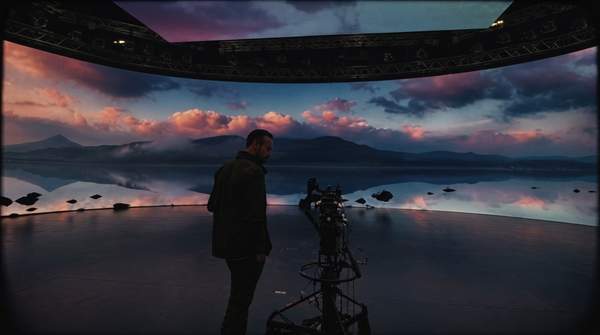
Virtual production integrates physical and digital elements in real-time. It moved from blockbuster films to commercial applications in approximately five years, offering consistent value in speed, creative control, and sustainability.
Strengths: Real-time visualization, improved actor performance, reduced need for travel and elaborate set builds, better realism than green screen | Limitations: High initial setup costs, requires specialized technical crew, complex workflow integration | Price: Varies by project scale and studio, often a significant investment.
LED Volume Stages & In-Camera VFX (ICVFX)
Best for: Productions requiring immersive digital environments and real-time visual effects directly on set.
LED volume stages, a critical hardware component, are expanding at more than 30% annually, according to Mordorintelligence. By January 2026, these stages and in-camera VFX (ICVFX) became a credible, repeatable method for shooting commercials, branded content, corporate films, music videos, and live broadcast segments, according to SPStudios Ca. The widespread adoption of LED volume stages and in-camera VFX (ICVFX) by January 2026 confirms their established role beyond experimental use.
Strengths: On-set visual effects, realistic lighting, immediate feedback for directors and actors, reduced post-production | Limitations: Large physical footprint, high power consumption, limited by LED panel resolution | Price: Substantial capital expenditure for setup, or daily rental rates for studio access.
Generative AI for Filmmaking
Best for: Visual effects, content generation, script analysis, and automating repetitive production tasks.
Generative AI is used by Netflix's 'The Eternaut' for complex scenes and by India's film studios to slash costs and timelines. Netflix's use of generative AI for complex scenes in 'The Eternaut' and India's film studios' use to slash costs and timelines demonstrates AI's direct impact on both creative execution and production efficiency.
Strengths: Accelerates content creation, reduces VFX costs, enables new creative possibilities, automates mundane tasks | Limitations: Ethical concerns, potential for bias, requires large datasets, creative control still evolving | Price: Subscription models for platforms, custom development costs for proprietary solutions.
Runway (AI Video Generation Platform)
Best for: Filmmakers, ad agencies, and studios seeking advanced AI-powered video editing and generation tools.
Runway added $40 million in annual recurring revenue in Q2 2026. This platform powers production workflows for filmmakers and ad agencies and has been used in films like 'Everything Everywhere All At Once'. Its use in major films validates AI's capacity for high-profile creative projects.
Strengths: Cutting-edge AI video synthesis, intuitive interface, integration with existing workflows, rapid prototyping | Limitations: Computationally intensive, output quality can vary, ethical considerations for generated content | Price: Tiered subscription plans, enterprise solutions available.
Proprietary Studio AI Tools (e.g. Amazon MGM Studios AI Studio)
Best for: Large studios aiming to integrate AI deeply into their specific production pipelines for efficiency, cost reduction, and IP protection.
Amazon MGM Studios will begin a closed beta program in March to test its AI tools. These tools aim to support creative teams, improve efficiency, reduce costs, and protect intellectual property. Amazon's 'House of David' series featured 350 AI-generated shots in season two, according to TechCrunch. Amazon MGM Studios' strategic investment in AI tools, including a closed beta program and 350 AI-generated shots in 'House of David' season two, signals a long-term commitment to integrating AI for competitive advantage and IP control.
Strengths: Tailored to specific studio needs, enhanced IP security, optimized for internal workflows, long-term strategic advantage | Limitations: High development costs, requires significant internal expertise, limited interoperability with external tools | Price: Internal investment, not publicly priced.
Software Platforms for Virtual Production
Best for: Production teams managing real-time graphics, 3D environments, and camera tracking within virtual production setups.
Software platforms held a 52% revenue share in the virtual production market in 2024 and led with 51.25% in 2025, according to Mordorintelligence. Vendors bundling software subscriptions with managed-service crews are positioning themselves as turnkey partners. Software platforms' dominance, holding a 52% revenue share in the virtual production market in 2024 and 51.25% in 2025, positions software as the central nervous system of virtual production, driving its functionality and accessibility.
Strengths: Centralized control, real-time rendering, robust asset management, flexible integration with hardware | Limitations: Steep learning curve, requires powerful computing infrastructure, licensing costs | Price: Subscription-based, perpetual licenses, or bundled with services.
AI for Production Workflow Optimization
Best for: Studios and production companies looking to streamline administrative tasks, scheduling, resource allocation, and post-production pipelines.
India's film studios deploy AI at scale to slash movie costs and production timelines. Amazon MGM Studios' AI Studio focuses on improving efficiency and reducing costs. India's film studios deploying AI at scale to slash movie costs and production timelines, and Amazon MGM Studios' AI Studio focusing on improving efficiency and reducing costs, demonstrate AI's direct impact on financial viability and project delivery speed.
Strengths: Reduces operational overhead, accelerates timelines, optimizes resource utilization, minimizes human error in repetitive tasks | Limitations: Requires careful integration with existing systems, data privacy concerns, initial setup complexity | Price: Software licenses, custom development, or service fees.
Real-time Content Creation Technologies
Best for: Any production aiming to accelerate creative iteration, reduce post-production cycles, and achieve immediate visual feedback.
Studios, broadcasters, and advertisers seek real-time content creation to lower travel, set-build, and post-production expenses. Virtual production using LED volumes consistently delivers value in speed and creative control. The demand for real-time capabilities reflects an industry-wide push for faster iteration and reduced overhead.
Strengths: Instant visualization, faster decision-making, greater creative flexibility, cost savings on traditional elements | Limitations: Requires specialized software and hardware, technical expertise, potential for rendering limitations | Price: Varies widely based on specific tools and scale of implementation.