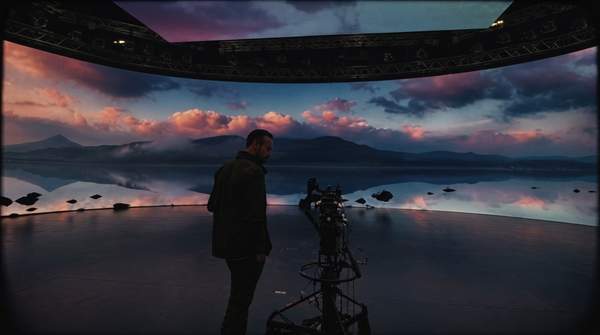
On a film set, a director can command a technical artist to replace desert dunes with a glowing alien landscape, fill the sky with stars, or set the sun—all in real time, while the camera rolls. This real-time capability is the essence of virtual production and real-time technology in filmmaking, merging physical and digital worlds to give creators unprecedented control. Unlike traditional methods that add visual effects months after filming, this technique captures fantastical environments directly in-camera.
What is Virtual Production in Filmmaking?
Virtual production is a filmmaking technique that combines live-action filming with real-time computer-generated imagery (CGI), directly joining the digital world with the physical as filming happens. This integration allows directors, cinematographers, and actors to see a close approximation of the final visual effect shot live on set—a significant departure from the traditional linear pipeline where visual effects are added in post-production.
The core of this process is powered by real-time game engines, such as Unreal Engine, which are capable of rendering photorealistic digital environments instantaneously. While the concept has been used in the broadcast industry for years to create live graphics for sports and news, its adoption in narrative filmmaking was popularized by productions like Disney's The Mandalorian. According to a report from ftrack, the worldwide market for virtual production reached $1.82 billion USD in 2022, signaling its growing importance in the industry.
How Virtual Production Works: A Step-by-Step Guide
The virtual production workflow fundamentally changes filmmaking's order of operations, emphasizing extensive preparation before cameras roll. A typical in-camera visual effects (ICVFX) shoot requires specific steps to come together.
Step 1: Digital Asset CreationLong before the cast arrives on set, the process begins in the digital realm. 3D artists and environment designers build the virtual world inside a real-time game engine. This involves creating everything the camera will see: landscapes, buildings, skies, and digital props. These assets must be highly detailed and optimized to be rendered instantly without sacrificing visual quality.
Step 2: Previsualization and Virtual ScoutingOnce the digital environment is built, key creative stakeholders can enter it virtually. Using VR headsets or specialized software, the director and cinematographer can "scout" the digital location. They can walk through the scene, plan camera angles, test lighting schemes, and block actor movements in a process called previsualization, or "pre-viz." This digital rehearsal phase allows for creative decisions to be made early, saving valuable time and money once physical production begins.
Step 3: The LED Volume SetupThe physical set, often called "The Volume," is typically a stage surrounded by large, high-resolution LED video panels. These panels form walls and sometimes a ceiling, creating an immersive space. The digital environment created in Step 1 is projected onto these screens. In the center of the volume, physical set pieces and props are placed to blend seamlessly with the virtual background, grounding the actors in a tangible space.
Step 4: Camera and Motion TrackingThe film camera is outfitted with motion tracking sensors. These sensors constantly communicate the camera's precise position, orientation, lens focal length, and focus distance to the game engine. This data is the critical link between the physical camera and the virtual world. Multiple tracking systems exist, from optical solutions that use infrared cameras to inertial measurement units (IMUs).
Step 5: Real-Time Rendering and Parallax EffectThis is where the technology's true power is revealed. As the physical camera moves, the tracking data is sent to the game engine, which then adjusts the perspective of the digital background in real time. This creates a perfect motion parallax—the visual effect where objects in the background appear to move more slowly than objects in the foreground. This makes the 2D image on the LED screens appear as a convincing 3D space from the camera's point of view, eliminating the flat look of a traditional backdrop.
Step 6: In-Camera VFX (ICVFX) FilmingWith everything synchronized, filming begins. Actors perform on the physical set, surrounded by the dynamic virtual environment. A key benefit, as explained by resources from Unreal Engine, is that the light from the LED panels illuminates the actors and physical props. This creates realistic, interactive lighting and reflections that are notoriously difficult to replicate with a traditional green screen. The final composite image—actor, physical set, and virtual background—is captured together in-camera, resulting in a nearly finished shot on the day of filming.
Common Pitfalls in Virtual Production and How to Avoid Them
Underestimating Pre-Production: A primary error is treating a virtual production shoot like a traditional one. The workflow is front-loaded, meaning the majority of creative and technical decisions must be finalized before filming. Inadequate asset creation or testing will lead to delays on the expensive LED stage. The key is to shift the mindset from "we'll fix it in post" to "we'll perfect it in pre-production."
Ignoring Moiré and Flicker: Filming a digital screen can introduce unwanted artifacts. Moiré is a distracting pattern that occurs when the camera's sensor grid conflicts with the pixel grid of the LED panel. Flicker can also be an issue depending on the refresh rate of the screens and the camera's shutter speed. These issues can be mitigated by careful lens choice, adjusting camera settings, and using diffusion filters, but they require technical attention.
Mismanaging the "Frustum": The realistic 3D parallax effect is only visible within the camera's direct line of sight, an area known as the camera frustum. Outside of this frustum, the image on the LED screens can appear distorted or flat. The crew must understand that only the view through the camera's lens is "correct," which requires a disciplined on-set workflow focused on what the camera is capturing.
Poor Lighting Integration: The light from the LED panels provides excellent ambient illumination and reflections, but it often isn't enough to serve as the primary (or key) light on actors. A common mistake is failing to supplement the digital light with physical lighting fixtures. The art is in seamlessly blending the practical lights with the light emitting from the screens to create a cohesive and cinematic look.
Key Considerations for Real-Time Technology in Film
Virtual production represents a philosophical shift in filmmaking, moving from a linear pipeline to a collaborative, real-time environment. This requires new skills and considerations, with the goal of capturing the "final pixel" in-camera—meaning the image recorded on set is as close to the finished product as possible. This minimizes guesswork and empowers creatives to make informed decisions together during the shoot.
The game engine is the undisputed heart of this workflow. According to MAGES Institute of Excellence, over 80% of virtual production stages are powered by Unreal Engine, which highlights its central role. The engine's ability to handle complex geometry, photorealistic materials, and dynamic lighting at high frame rates is what makes real-time rendering for film possible. Teams must include specialists, often called "brain bar" operators, who are experts in the engine and can make live adjustments to the virtual environment during a take.
The table below outlines some key differences between virtual production using an LED volume and traditional green screen techniques.
| Feature | Virtual Production (LED Volume) | Traditional Green Screen |
|---|---|---|
| On-Set Visualization | Final background is visible to cast and crew in real time. | Actors perform in front of a solid color; background is imagined. |
| Lighting & Reflections | LED panels provide realistic, dynamic lighting and reflections on actors and props. | Lighting must be simulated; green spill can contaminate the shot. |
| Workflow Timeline | Heavily front-loaded in pre-production; post-production is streamlined. | Post-production intensive; requires keying, compositing, and color matching. |
| Actor Performance | Actors can see and react to their environment, aiding immersion. | Actors must rely on imagination, which can be challenging. |
| Creative Iteration | Changes to the environment can be made live on set. | Changes are made during post-production, often with delays. |
Frequently Asked Questions
Is virtual production cheaper than traditional filmmaking?
The cost is a trade-off. Virtual production requires a significant upfront investment in pre-production, technology, and specialized crew. However, it can lead to substantial savings by reducing or eliminating the need for location travel, set construction, and extensive post-production compositing. For projects with multiple complex environments, the cost benefits can be considerable.
How does virtual production affect actors' performances?
Many industry professionals report that virtual production enhances acting. Unlike a sterile green screen environment, an LED volume allows actors to see the world they are supposed to be in. This immersion helps them deliver more grounded and believable performances, as they can directly react to the visual cues around them.
Can virtual production replace green screens entirely?
It is unlikely to replace green screens completely. Green screen technology remains a highly effective and cost-efficient tool for specific tasks, such as integrating digital characters that need to be composited behind an actor or for shots where a full LED volume is impractical. The two techniques are best seen as complementary tools in the modern filmmaker's toolkit.
The Bottom Line
The key takeaway here is that virtual production, powered by real-time technology, is a paradigm shift that moves post-production into production. It collapses the traditional filmmaking pipeline, fostering greater collaboration and giving creators the ability to build and shoot in fantastical worlds with immediate visual feedback. For any filmmaker or production team considering this technology, the first step is not buying equipment, but investing in the skills and planning required for a digitally-driven pre-production workflow.