Behind the Scenes

What Is Virtual Production in Filmmaking? A Comprehensive Guide

Virtual production is revolutionizing filmmaking by blending physical and digital worlds in real time. This comprehensive guide explores how technologies like LED walls and real-time rendering offer filmmakers unprecedented creative control and efficiency.

VR
Victor Ren

March 30, 2026 · 6 min read

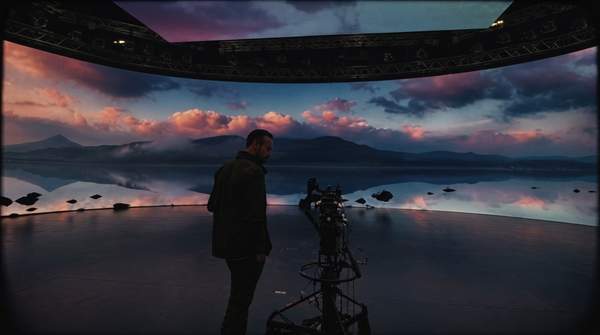
A film crew on a soundstage using large LED screens to display a realistic alien desert, with actors performing in front of the immersive digital environment, showcasing virtual production technology.

How can a television crew shoot a desert planet, a frozen wasteland, and a lava-filled world all from a single soundstage? The answer lies in virtual production, a set of technologies revolutionizing filmmaking by blending the physical and digital worlds in real time. This approach, famously showcased in shows like The Mandalorian, is moving complex visual effects from months of post-production directly into the camera on the day of the shoot, giving filmmakers unprecedented creative control.

Recent advancements in real-time graphics, LED display technology, and camera tracking have made virtual production a powerful tool, shifting the production pipeline from pre-visualization to final photography. Directors, cinematographers, and actors now work in interactive, immersive digital environments instead of static green screens. This guide explores its core principles and applications.

What Is Virtual Production?

Virtual production is an approach to filmmaking that uses real-time technologies to combine live-action footage with computer graphics simultaneously during filming. Think of it as an evolution of the green screen. Instead of actors performing in front of a blank green canvas and imagining the world that will be added later, they perform inside a dynamic, photorealistic digital environment projected onto massive LED screens. The final composite image is captured directly in the camera, a process known as in-camera visual effects (ICVFX).

A typical on-set virtual production (OSVP) stage, often called "The Volume," relies on several interconnected components. While setups vary, these core elements are essential:

  • LED Walls: Large, high-resolution video panels that surround the physical set. These walls display the computer-generated background and can even form a ceiling to create a fully enclosed, immersive space.
  • Real-Time Rendering Engine: Powerful software, often a video game engine like Unreal Engine, is used to create and render the digital environment. This engine processes data instantly to generate the images displayed on the LED walls.
  • Camera Tracking System: Sensors are placed on the physical camera to track its precise position, orientation, and lens settings in 3D space. This data is fed to the real-time engine.
  • Media Servers: High-performance computers that process the imagery from the game engine and deliver it to the LED panels at the required resolution and frame rate.

How LED Walls Revolutionize On-Set Filming

Large-scale LED walls fundamentally change the on-set environment in modern virtual production. They link the camera's physical movement to the digital background's perspective. As the cinematographer moves the camera, a real-time engine adjusts the background to create perfect parallax—where distant objects appear to move slower than foreground objects—capturing a convincing illusion of depth in-camera.

One of the most significant advantages over traditional green screen techniques is interactive, realistic lighting. The LED panels emit light, casting authentic colors and dynamic reflections onto actors, props, and costumes. If a starship flies by in the background, its lights will naturally reflect off a character's shiny helmet. This solves a major challenge of green screen compositing, where lighting must be meticulously recreated in post-production. The result is a more seamless and believable integration of live-action and digital elements.

High-profile projects have validated this technology. While the Disney+ series The Mandalorian popularized the technique, earlier projects laid the groundwork. The 2013 film Gravity used a "Light Box" of 1.8 million LED bulbs to project space environments around actors, providing realistic, moving light sources. According to Showrunner, FX's drama Snowfall used a 65-foot LED wall for a penthouse set, reportedly reducing location time by at least a third.

Understanding Real-Time Rendering in Virtual Filmmaking

At the heart of virtual production is real-time rendering. This is the computational process that allows a computer to generate a photorealistic image from a 3D model so rapidly that the illusion of live motion is created. This technology, perfected over decades in the video game industry, is what enables the digital world on the LED screens to react instantly to changes made by the filmmakers. The director can ask for the sun to be lower in the sky or for a mountain to be moved, and the visual effects team can execute that change live on set.

The workflow begins with visual effects artists building digital environments, or "assets," as fully realized 3D worlds in a game engine. On set, the camera tracking system constantly sends data to the rendering engine. This engine calculates the correct camera perspective within the 3D world and displays that view on the LED wall. This entire cycle—from camera movement to rendering the new perspective—occurs in milliseconds, making the process invisible.

This real-time capability extends beyond principal photography into pre-production. In a process called pre-visualization, or "previs," filmmakers can use virtual reality headsets to walk through digital sets, plan camera angles, and experiment with lighting long before a physical set is built. Director Jon Favreau famously used a similar process for the 2019 film The Lion King, leveraging game engines and VR to direct a completely computer-generated film with the interactive tools of a live-action shoot.

Why Virtual Production Matters

Virtual production's primary advantage is fusing production and post-production, granting filmmakers immense creative flexibility. Directors can control every environmental aspect, from weather to time of day, achieving their precise vision without location shoot constraints. This benefits science fiction, fantasy, historical dramas, car commercials, and projects requiring complex or hard-to-reach settings.

Virtual production offers substantial efficiency gains by eliminating travel to multiple locations, saving significant time and money on logistics. A single soundstage can reconfigure as a desert, jungle, or spaceship interior on consecutive shoot days, also reducing a production's carbon footprint. While initial stage investment is high, long-term savings in travel, location fees, and post-production hours are considerable.

The field's growing importance is reflected in educational and economic development. For example, Louisiana State University announced a Virtual Production Program for Real-Time Filmmaking on August 18, 2021, receiving $1.25 million from Louisiana Economic Development. This investment underscores the industry's commitment to training new filmmakers and technicians proficient in these emerging workflows.

Frequently Asked Questions

Is virtual production just a better green screen?

Virtual production differs fundamentally from green screen, despite often replacing it. Its key advantages are capturing final-pixel imagery with realistic, interactive lighting and reflections directly in-camera. This "in-camera VFX" approach significantly reduces complex post-production compositing for green screen shots and allows actors to perform in an immersive environment.

What was the first movie to use virtual production techniques?

While no single "first" project exists, virtual production principles evolved over many years. Films like Avatar (2009) pioneered real-time visualization for directors, and Gravity (2013) used its innovative LED "Light Box" for immersive, realistic actor lighting. These projects were crucial stepping stones to today's integrated LED wall systems.

Do you still need visual effects artists with virtual production?

VFX artists, no longer focused primarily on post-production compositing, are now heavily involved in pre-production and on-set operations. They create, optimize, and manage the real-time 3D environments that form the foundation of virtual sets.

The Bottom Line

Virtual production represents a fundamental change in the filmmaking process, merging the digital and physical realms on set in real time. It moves complex visual effects work from a lengthy post-production phase directly into the camera during principal photography. The key takeaway here is that by leveraging technologies like LED walls and real-time game engines, virtual production empowers creators with greater control, efficiency, and creative freedom than ever before.