Behind the Scenes

The AI Shift: How New Tools Are Reshaping Global Film Production

For decades, a screenplay’s journey from page to production began with a slow, subjective process. Today, new artificial intelligence tools are transforming global film production workflows, starting with the script itself.

VR
Victor Ren

April 2, 2026 · 7 min read

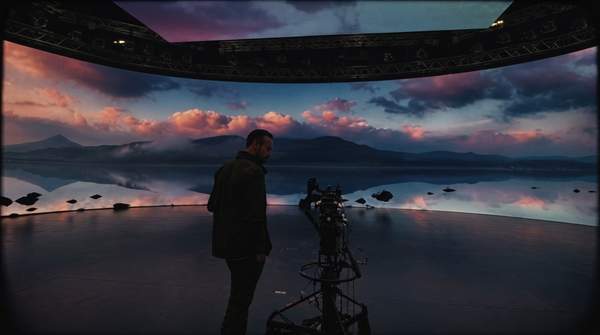
A visually striking image of a modern film set, where advanced AI technology, represented by glowing holographic screens and robotic assistants, seamlessly integrates with human filmmakers, symbolizing the transformation of global film production.

A startup named Quilty can deliver a detailed market and creative analysis of a screenplay in as little as four minutes, fundamentally changing how projects are developed, greenlit, and produced. This shift from months of human reader coverage to minutes of algorithmic evaluation is transforming global film production workflows, starting with the script itself. The growing integration of this technology is a central topic for industry events, such as the upcoming 'AI & Filmmaking Week 2026' to be hosted by the University of Hong Kong.

What Changed: The Catalyst for Algorithmic Production

For decades, film development relied on "expensive, disconnected solutions and informal networks for its decision making," as a source quoted by TheWrap noted. This traditional model involved multiple script readers, lengthy feedback turnaround times, and high subjectivity, creating significant barriers for new writers and proving time-consuming.

The inflection point arrived with the widespread accessibility and sophistication of generative AI and large language models. These technologies moved beyond simple text generation to complex pattern recognition, sentiment analysis, and predictive modeling. This technological leap enabled the creation of specialized platforms capable of dissecting creative works with a new level of speed and data-driven insight. The catalyst was not a single invention but the convergence of computational power, massive datasets, and refined algorithms, making tools that were once theoretical now commercially viable and scalable.

AI in Pre-visualization and Script Analysis: New Frontiers

Quilty, a unified intelligence tool, automates script analysis and pre-visualization in the earliest stages of production. By streamlining development and providing rapid, data-centric feedback, Quilty changes the fundamental economics of project evaluation for creators and executives, replacing traditionally manual script coverage.

Quilty provides users with a proprietary 'Quilty Score,' a metric derived from an analysis across four distinct dimensions.

  1. Story & Craft: Evaluation of narrative structure, character development, pacing, and dialogue.
  2. Commercial Viability: Analysis of genre conventions, target audience appeal, and market trends to forecast box office or streaming potential.
  3. Cultural Resonance: Assessment of thematic relevance, social impact, and potential for public discourse.
  4. Production Reality: A practical breakdown of the script's logistical requirements, including potential budget ranges, location needs, and casting complexity.

The platform operates on a freemium model. A user can upload a script and receive a free preview analysis. For a comprehensive evaluation, the service costs $49.99. This pricing structure makes sophisticated analytics accessible not just to major studios but also to independent filmmakers and emerging writers, democratizing a critical step in the development process.

Beyond the written word, AI is also reshaping visual development. According to a report in Variety, generative AI tools are being integrated directly into pre-visualization pipelines. The Chinese historical drama 'Swords Into Plowshares' reportedly used the Kling AI model at every stage of production. This included the rapid generation of pre-vis material, allowing the director and cinematographer to experiment with camera angles, lighting, and shot composition long before arriving on set, saving significant time and resources.

Revolutionizing Post-Production: AI-Powered Editing and VFX

In post-production, 'Swords Into Plowshares' used Kling AI to generate and animate a scavenging raven, which was then composited seamlessly onto live-action background plates. This demonstrates how AI automates complex tasks and creates new visual possibilities, allowing entire digital assets to be created within an AI model and bypassing several stages of traditional 3D modeling and animation.

This trend is accelerating as major technology companies release more powerful video generation models. A report from PYMNTS.com states that in 2026, Google, Runway, and ByteDance all released new AI video tools aimed at allowing creators to produce content at a fraction of the traditional cost and time. This market acceleration is validated by major industry investments. The same report notes that Netflix recently acquired InterPositive, an AI filmmaking company founded by Ben Affleck, specifically to develop tools that support post-production tasks.

AI is also finding a crucial role in film restoration and adaptation. As detailed by The Conversation, AI was instrumental in transferring imagery from the 1939 classic 'The Wizard of Oz' to the massive, 160,000-square-foot dome at the Sphere entertainment venue. The process involved a technique known as 'AI outpainting,' where the algorithm generates new imagery consistent with the original film's style to expand the frame and enhance resolution for the unique format. In a similar vein, AI media entrepreneur Edward Saatchi is reportedly using his platform, Showrunner, to recreate and reincorporate lost footage from Orson Welles’ 1942 feature 'The Magnificent Ambersons,' demonstrating AI's potential to reclaim cinematic history.

The Economic and Creative Impact of AI on Global Film

The integration of AI is creating a new landscape of winners and losers. The primary beneficiaries are entities that can leverage the technology for efficiency and scale. Startups like Quilty are creating entirely new market categories. Major studios are also moving quickly to capitalize on the trend. Disney, for example, entered into a partnership with OpenAI to allow its intellectual property to be used within the Sora video generation platform, according to PYMNTS.com. This move signals a strategy to control how its valuable characters are utilized in the emerging AI ecosystem.

Another significant group of winners are independent creators. Professor Ruby Yang, speaking about the upcoming HKU event, stated that "Generative AI is lowering the barriers to filmmaking and opening the door for young creators around the world." This technological access could foster a new wave of storytellers from regions previously excluded from the global film market due to high production costs.

However, this shift is also creating displacement and significant challenges. The roles of script readers and development analysts are directly threatened by automated platforms. More broadly, the ability of AI to generate realistic human likenesses and mimic creative styles raises profound economic and ethical questions. The viral spread of a 15-second, AI-generated clip depicting Tom Cruise battling Brad Pitt, created with an advanced AI model in February 2026, brought this issue to a head. The clip reportedly prompted a swift backlash from Hollywood studios, with Disney sending a cease-and-desist letter over concerns of intellectual property infringement and the unauthorized use of actor likenesses. This incident highlights the central conflict between technological capability and the legal frameworks protecting creative labor and copyright.

Future Trends: AI's Role in Shaping Filmmaking's Next Era

Industry insiders expect the next phase of AI in film to be defined by greater creative control. The conversation at industry events like FilMart has reportedly shifted from the novelty of AI generation to the development of 'directable AI.' This concept refers to models that provide filmmakers with granular control over outputs, allowing them to specify camera movement, character performance, and environmental details with precision. This evolution marks a transition from AI as a random content generator to AI as a sophisticated, responsive filmmaking tool.

The release of Kling AI's 3.0 model in February is a concrete example of this progression. According to Variety, the update introduced advanced camera control and improved character consistency, features designed specifically for a professional production workflow. This focus on directability is crucial for integrating AI into the established craft of filmmaking, where intention and control are paramount.

Looking ahead, academic and industry collaboration will be key to navigating this new terrain. The University of Hong Kong's 'AI & Filmmaking Week 2026' is set to convene filmmakers, technologists, and ethicists to examine these issues. The event, which will feature the Asian premiere of South Korea’s first AI-generated feature film, underscores the global nature of this transformation. As an industry report projecting market trends through 2033 suggests, the economic and creative stakes will only continue to grow. The key takeaway here is that the industry is moving past the question of if AI will be used, and is now focused on how it will be directed, governed, and integrated into the art of cinema.

Key Takeaways

  • From Novelty to Utility: AI is transitioning from a generative curiosity to a practical, integrated tool across the entire production pipeline. Platforms like Quilty are automating pre-production analysis, while models like Kling AI are streamlining complex VFX and pre-visualization workflows.
  • Efficiency is the Core Driver: The primary impact of AI in its current form is on workflow optimization, cost reduction, and speed. This applies to script development, visual effects generation, and even specialized tasks like film restoration and adaptation for new formats.
  • Investment and Conflict Coexist: Major studios are actively investing in and partnering with AI firms (e.g., Netflix/InterPositive, Disney/OpenAI). However, significant legal and ethical challenges surrounding intellectual property and digital likenesses, highlighted by the ByteDance Seedance 2.0 controversy, remain a major point of unresolved industry conflict.
  • The Next Frontier is Control: The future development of AI in filmmaking is focused on 'directable AI.' This evolution aims to provide creatives with precise, granular control over AI-generated content, transforming it from an unpredictable generator into a deliberate instrument for storytelling.