Film and Pen
Film & TVContent CreationProductionBooksAdvertising
Film and Pen

Where creativity meets industry: film, TV, books, and media.

Film & TVContent CreationProductionBooksAdvertisingCreators
WritersContactPrivacyTerms
Artificial IntelligenceRetail MediaFilmScreenwritingFilmmakingCinematographyAiAdvertising

© 2026 Film and Pen. All rights reserved.

  1. Home
  2. /Film & TV
  3. /What Are Visual Storytelling Principles in Film and TV?
Film & TV

What Are Visual Storytelling Principles in Film and TV?

The "empty shot"—a scene devoid of characters—appears simple, yet its definition and application remain contentious in academic research.

JM
Julian Mercer

July 1, 2026 · 5 min read

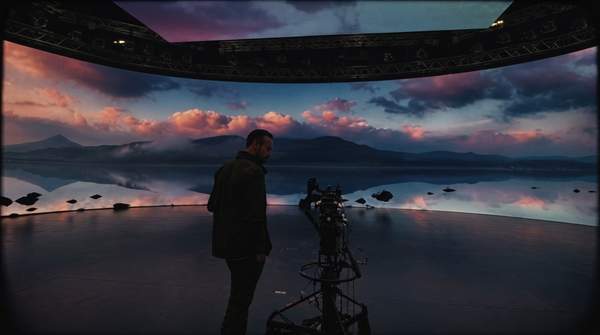
Director and cinematographer collaborating on a scene, emphasizing the technical and artistic aspects of visual storytelling in film and TV.

The "empty shot"—a scene devoid of characters—appears simple, yet its definition and application remain contentious in academic research. This complexity, detailed by Nature, reveals the hidden precision demanded by visual storytelling in film and television as of 2026. Such frames are crucial for conveying spatial relationships, subtle emotions, and establishing mood before action begins, depicting the vastness of a setting or introducing new locations.

Visual storytelling often feels intuitive, a spontaneous act of creative expression. Yet, its most powerful techniques rest on a precise, academically debated, and highly technical foundation. A camera's position, for instance, profoundly impacts a viewer's emotional connection with a character, according to Routledgelearning. This technical nuance operates entirely below conscious awareness, subtly shaping perception and guiding emotional responses without explicit dialogue or overt action.

Mastering these underlying visual principles is not merely an artistic preference; it is an essential requirement for creators to craft truly compelling narratives. When filmmakers meticulously apply these techniques, audiences can fully appreciate the depth of cinematic artistry, engaging with stories on a profound, subconscious level where images speak volumes beyond their surface.

The Language of Images: Defining Visual Storytelling

Visual storytelling is the process of conveying story, idea, or emotion through the language of image, as succinctly defined by Studiobinder. This expansive discipline weaves cinematography, editing, sound, and visual effects into a compelling video experience. Its ultimate aim: to immerse viewers deeply and seamlessly into a narrative world.

Beyond mere imagery, the craft's key elements include narrative arc, characters, emotion, empathy, composition, pacing, editing, and sound design, according to Storyblocks. These components form a comprehensive toolkit of sensory elements, meticulously chosen to build emotionally resonant narratives. Together, Studiobinder's definition and Storyblocks' elements reveal that visual storytelling is not a singular technique, but a symphony of precise choices. This interplay constructs a visual grammar, allowing filmmakers to communicate complex ideas and feelings through the silent language of the screen.

The Building Blocks: Composition, Mise-en-scène, and Editing

Bruce Block, a renowned theorist, identifies seven basic ingredients that constitute the very fabric of visual storytelling: Space, Line, Shape, Tone, Color, Movement, and Rhythm. These fundamental elements, described by Studiobinder, provide a foundational grammar for cinematic expression. They dictate how visual information is organized, perceived, and interpreted. A stark vertical line, for example, can convey power or rigidity; a warm color palette might instantly evoke comfort or nostalgia.

Mise-en-scène further encompasses everything placed within the frame: sets, props, lighting, costume, character blocking, and shot composition, as Studiobinder meticulously explains. This deliberate arrangement of visual components directly influences mood, character perception, and a scene's overall thematic resonance. Editing, the art of cutting and assembling finished film, then shapes narrative flow and rhythm, guiding audience attention and manipulating their sense of time and space.

These fundamental ingredients—from static compositional choices to the dynamic art of editing—form an invisible architecture. This structure shapes how an audience perceives characters and narrative, often without conscious awareness. Storyblocks presents visual storytelling as a cohesive combination of elements, implying a clear understanding of its components. Yet, academic research, as detailed by Nature, reveals that even foundational elements like the "empty shot" have contentious definitions and applications. This unresolved theoretical framework for crucial elements challenges the notion of a fully understood 'craft', suggesting that even experienced practitioners may be operating on an incomplete understanding of their own tools.

Beyond Intuition: The Subconscious Power of Visual Cues

Precise camera movements—a deliberate pan or a subtle tilt—work in intricate concert with meticulously crafted mise-en-scène. They manipulate viewer perception far beyond conscious thought. These technical elements contribute to a comprehensive system, shaping how audiences interpret character motivations, emotional states, and story progression. A slow, creeping dolly-in builds suspense; a rapid cut to a close-up emphasizes sudden realization, all operating below explicit awareness.

Companies relying on 'intuitive' visual content creation often miss the profound, subconscious impact achievable through a precise understanding of elements like camera position and mise-en-scène. Prioritizing artistic flair over rigorous technical application leaves significant emotional and perceptual influence untapped. The ongoing academic debate around foundational techniques underscores that mastering visual storytelling demands a rigorous, technical approach, not merely an inherent artistic sensibility. True expertise lies in understanding its debated foundations, not just applying established methods. This implies a critical need for formal education and research to inform practical application, elevating the craft beyond mere instinct.

This combination of highly technical, often invisible elements creates a comprehensive system. It profoundly shapes viewer perception and emotion, far beyond what a simple narrative arc alone could achieve. The subtle interplay of light, shadow, and movement can evoke dread or elation, forging an immersive connection that transcends mere plot points.

Crafting Connection: Why Visual Principles Are Paramount

A compelling video follows a clear narrative arc—a beginning, middle, and end—according to Storyblocks, providing the essential framework for a coherent story. This narrative backbone is not merely a sequence of events; it is powerfully reinforced and enriched by specific visual choices. The deliberate application of these visual principles is indispensable for creating immersive worlds that draw the audience into the narrative's emotional core.

Specific camera movements, such as a pan—scanning space left or right on the tripod’s axis—contribute significantly to this immersion, as detailed by Routledgelearning. This horizontal sweep reveals sprawling landscapes or follows a character's gaze, expanding environmental understanding. Similarly, a tilt shifts the camera’s perspective vertically, drawing attention skyward or downward, guiding the viewer's eye and emotional response through a carefully orchestrated visual journey.

The intricate design of visual elements, from narrative structure to minute camera movements, ultimately elicits deep emotional responses. Mastering these techniques transforms mere viewing into a profound experience, where every frame contributes to a rich tapestry of feeling and meaning. Creators must prioritize this technical precision, moving beyond surface-level aesthetics, to truly resonate with viewers and etch their stories into the collective consciousness. This implies a future where the most impactful narratives will be those built on a foundation of deep technical understanding, not just creative impulse.

By 2026, the insights from figures like Bruce Block, who meticulously dissects visual storytelling into its core elements, will likely prove indispensable for production companies. Studios appear poised to move beyond generalized artistic interpretations, embracing the rigorous, technical precision that truly elevates cinematic narratives. This shift promises to craft experiences resonating on an unseen, subconscious level, etching stories into the collective consciousness with unparalleled depth.

Related Coverage from Film & TV

  • Major Literary Adaptations on TV and Film Through 2026
  • What Are Visual Storytelling Principles in Cinema?

Tags

Visual StorytellingFilmmakingCinematographyFilm TheoryTelevision ProductionScreenwritingDirecting
JM

Julian Mercer

Film Editor

Julian writes about film, television, and storytelling craft for Film and Pen. He brings a cinematic eye to dissecting narrative and the art of visual storytelling.

More from Film & TV

Split image: prestigious award ceremony on one side, lively living room audience on the other, symbolizing critical acclaim versus audience love for Summer 2026 TV.

Summer 2026 TV: Critical Acclaim vs. Audience Love

Apple's series "Widow's Bay" has already generated significant word of mouth and is considered a potential contender for this year's Emmys, signaling a summer where streaming originals are poised to d

Julian Mercer· Jul 1
A dynamic visual collage blending classic book covers with dramatic stills from upcoming film and TV adaptations of famous novels, set to release by 2026.

Major Literary Adaptations on TV and Film Through 2026

In 2026 alone, audiences can expect to see Emily Brontë's 'Wuthering Heights' alongside Suzanne Collins' 'Hunger Games' prequel and Colleen Hoover's 'Verity' on screen, signaling an unprecedented conv

Julian Mercer· Jun 30
Mel Brooks' Blazing Saddles campfire scene with characters under a starry desert sky, evoking Western adventure and comedy.

Mel Brooks: Blazing Saddles Funniest, Diverse Legacy

The American Film Institute officially reordered its "100 Years.

Julian Mercer· Jun 30
Journalists from Variety accepting 16 first-place awards at the Southern California Journalism Awards ceremony, with the Variety logo prominently displayed.

Variety wins 16 Southern California Journalism Awards

Variety secured 16 first-place awards at the 68th annual Southern California Journalism Awards.

Julian Mercer· Jun 29

Trending Now

1
Why Guy Davies Clicks With Brands: 5 Reasons His The Go-To Commercial Photographer in Australia

Why Guy Davies Clicks With Brands: 5 Reasons His The Go-To Commercial Photographer in Australia

Advertising· 10 views
2
Your Ultimate Guide to Joining the TIFP Universe: A Fresh Take on Superheroes

Your Ultimate Guide to Joining the TIFP Universe: A Fresh Take on Superheroes

Books· 7 views
3
Books and film equipment in a cozy study, symbolizing the fusion of writing and filmmaking craft.

10 Best Books for Aspiring Writers and Filmmakers in 2026

Books· 6 views
4
Media and retail leaders finalize a major deal, symbolizing the convergence of traditional media and digital advertising platforms in the CTV era.

Retail Media's CTV Pivot: Fox's $22B Roku Acquisition

Advertising· 5 views
5
A futuristic film production set showcasing the integration of AI interfaces, holographic displays, and advanced virtual production technology alongside traditional filmmaking equipment.

Emerging Filmmaking Production Technologies Changing the Game

Production· 5 views
6
John Oliver, host of 'Last Week Tonight', makes unexpected guest appearances on the iconic daytime soap operas 'Days of Our Lives' and 'General Hospital'.

John Oliver guest stars on Days of Our Lives & General Hospital

Behind The Scenes· 6 views