What is Virtual Production Technology and Its Filmmaking Applications?

In 2025, virtual production technology powered over 3,500 projects globally, a seismic shift in how films and shows are made, according to SNSInsider .

VR
Victor Ren

May 29, 2026 · 5 min read

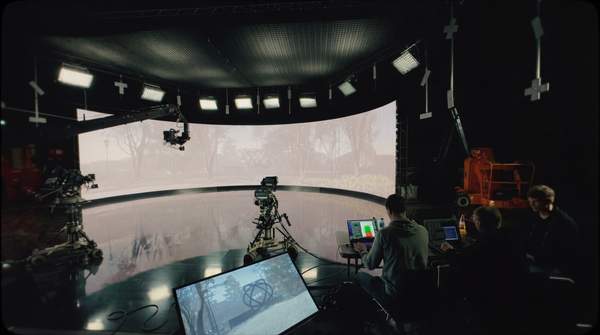
Filmmakers utilizing virtual production technology, with actors interacting with holographic sets and real-time rendering displayed on screens.

In 2025, virtual production technology powered over 3,500 projects globally, a seismic shift in how films and shows are made, according to SNSInsider. Over 55% of studios and streaming platforms adopted virtual reality (VR), augmented reality (AR), and real-time rendering technologies in the same year. Widespread adoption signals a deep reliance on advanced digital workflows to accelerate content creation and enhance creative control.

While traditional filmmaking methods still dominate much of the industry, virtual production's market value is skyrocketing, indicating a rapid, irreversible transition. The divergence between established practices and emerging, more efficient pipelines means virtual production is now a scalable, accessible workflow for a wide array of productions, not just tentpole blockbusters.

Companies that fail to integrate virtual production technologies risk falling behind competitors already leveraging its efficiency and creative potential. Technological evolution alters project evaluation and funding mechanisms. The rapid adoption by over 55% of studios and streaming platforms in 2025 confirms that companies clinging to traditional, linear production pipelines face measurable risk of being outmaneuvered by more agile, virtually-enabled competitors.

What is Virtual Production and How Does it Work?

Virtual production integrates advanced software and visualization techniques. Filmmakers see and interact with digital environments in real-time during production, minimizing extensive physical sets and location shoots. The software segment led the market, accounting for over 41% of global revenue in 2025, according to Grandviewresearch. This confirms that the true value and innovation in virtual production lie less in physical hardware and more in the underlying digital tools and real-time rendering capabilities.

One critical application is "pitchvis," a pre-production visualization tool effective in greenlighting major films, as reported by CG Spectrum, including major films like "Godzilla" (2014), "Men in Black 3," and "World War Z," as reported by CG Spectrum. This success means industry gatekeepers now prioritize projects leveraging real-time visualization. Filmmakers can present fully realized digital scenes, offering studios a clearer vision of the final product and reducing speculative investment risks, altering how creative concepts are evaluated and funded.

The Explosive Growth of Virtual Production

The global virtual production market, valued at USD 3.86 billion in 2024 (historical data), shows significant expansion. It is projected to grow from USD 4.44 billion in 2025 to USD 13.47 billion by 2033, according to Skyquestt. This represents a Compound Annual Growth Rate (CAGR) of 14.9% during the forecast period of 2026–2033.

These projections confirm sustained expansion, positioning virtual production as a critical investment area. The figures suggest a steady, long-term increase in market valuation, driven by continuous technological advancements and broader adoption. This growth indicates a fundamental shift in industry spending towards these digital workflows.

The rapid market expansion, projected to reach up to USD 16.71 billion by 2035, coupled with over 55% of studios adopting VR, AR, and real-time rendering in 2025, confirms virtual production has crossed the chasm from niche innovation to mainstream industry standard.

Global Market Dynamics and Diverse Projections

North America held the largest revenue share, exceeding 35%, in the global virtual production market in 2025, according to Grandviewresearch. This regional dominance points to a concentration of early adopters and significant investment in virtual production technology within the North American entertainment sector, even as other regions expand capabilities.

The global virtual production market size was valued at USD 2.84 billion in 2025 according to Grandviewresearch. This contrasts with Skyquestt's valuation of USD 4.44 billion for the same year, with a figure of USD 3.70 billion. This significant discrepancy suggests the market is still nascent and complex to measure, with different methodologies yielding widely varied current valuations.

Despite these differing current valuations, Grandviewresearch projects the market to reach USD 12.25 billion by 2033. Grandviewresearch projects a Compound Annual Growth Rate (CAGR) of 20.4% for the virtual production market from 2026 to 2033, whereas Skyquestt forecasts a lower CAGR of 14.9% for the same period. This indicates uncertainty regarding the precise velocity of market expansion, which could influence investment strategies and competitive positioning for virtual production technology filmmaking applications.

Strategic Importance and Future Impact on Filmmaking

The virtual production market is expected to grow at a Compound Annual Growth Rate (CAGR) of 14.9% from 2026 to 2033, according to both Grandviewresearch and SNSInsider. The accelerated growth rate surpasses many other segments within the entertainment technology sector, with the market projected to reach USD 16.71 billion by 2035, as reported by SNSInsider.

This scale of projected growth confirms virtual production is not an incremental improvement but a significant shift demanding strategic attention. Studios that fail to invest heavily in software-driven real-time rendering capabilities will find themselves increasingly unable to compete on efficiency, creativity, or speed to market. Virtual production technology reshapes the entire project lifecycle, streamlining workflows, reducing costly reshoots, and providing immediate creative feedback, directly impacting project timelines and budgets.

Common Questions About Virtual Production

What are the benefits of virtual production in filmmaking?

Virtual production offers enhanced creative control, reduced on-location shooting needs, and accelerated post-production timelines. Filmmakers visualize complex scenes in real-time, making immediate adjustments to environments and lighting. This workflow also allows for safer production environments and greater flexibility in scheduling.

How does virtual production work in movies?

Virtual production in movies typically involves LED volumes displaying digital environments, tracked cameras, and real-time rendering engines like Unreal Engine or Unity. Actors perform on a physical stage while seeing the virtual world around them, often interacting with virtual elements. This integration allows for seamless blending of practical and digital effects during principal photography.

What are the key components of virtual production?

Key components of virtual production include advanced camera tracking systems, large LED screens or green screens, powerful real-time rendering software, and robust data management systems. These elements work in concert to create interactive digital environments that can be adjusted dynamically. The integration of these technologies allows for immediate feedback and iterative creative development.

The Future of Filmmaking is Virtual

By Q4 2026, major studios like Industrial Light & Magic will likely expand their virtual production stages, further solidifying this workflow as an industry staple that defines competitive advantage in the coming years.