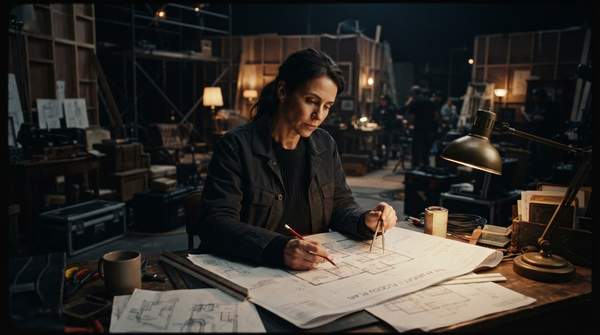
For a major film production exceeding £30 million, art department crew members adhere to an 11-hour workday, plus an hour for lunch, a schedule meticulously defined by union agreements rather than creative whim. This structured framework dictates the daily operations for many professionals involved in visual storytelling, ensuring predictable working conditions even as they craft imaginative worlds. Rigorous adherence to these contractual hours supports the creative output of the film and TV art department, forming its industrial backbone.
The art department is celebrated for its boundless creativity in building fantastical worlds, but its day-to-day operations are strictly governed by detailed union contracts and specific working conditions. This inherent tension between artistic freedom and contractual obligation shapes the working reality for those responsible for a project's visual identity, especially in the context of film and TV art department roles in visual storytelling in 2026.
As the demand for high-quality visual storytelling continues to grow across film and TV, the intricate balance between artistic freedom and the protections afforded by labor agreements will likely become an even more critical factor in attracting and retaining top talent.
For film, the details of props and set design hold significantly more importance than in stage production, according to The Ithacan. The emphasis on intricate detail highlights the art department's critical function in establishing the visual authenticity and immersive quality of cinematic environments. The department serves as the creative engine behind cinematic worlds, crafting believable and immersive environments fundamental to a film's narrative success.
Art department professionals are responsible for every visual element that appears on screen, excluding actors and their costumes. This includes set design, prop selection, graphic elements, and even the overall color palette, all of which contribute to the film's aesthetic and thematic resonance. Their work directly translates the script's abstract descriptions into tangible visual realities, making abstract concepts concrete for the audience.
The art department's influence extends to shaping audience perception and emotional engagement. By meticulously designing the settings and objects within a scene, they can evoke specific moods, historical periods, or fantastical realms, guiding the viewer's interpretation of the story. Their deep involvement in the film's visual style confirms their indispensable role in modern filmmaking.

The Unseen Framework: Union Agreements and Working Conditions
The BECTU Art Department committee bases its 2025/2026 Rate Card changes on a 2.60% increase over the previous year, aligning with the Construction Branch's annual inflation increase, according to filmbase. Benchmarking against an industrial sector like construction, rather than a metric tied to creative industry growth, highlights the structured financial valuation framework for these highly specialized creative roles.
Working hours for TV Drama Productions following the PACT - BECTU TV Drama Agreement are typically 10 hours plus one hour for lunch (10+1). However, flexible schedules like Semi-continuous working days (SCWD: 9.5 hours plus 30 minutes for a meal break) or Continuous working days (9 hours with no specified meal break, often incorporating eating on set).days (CWD: 9 hours with no specified meal break, often incorporating eating on set) can be scheduled if mutually agreed, as detailed by filmbase. Flexibility within a union framework demonstrates a capacity for adapting to production demands while maintaining contractual clarity.
Significantly, art department, set decoration, and graphics personnel do not typically perform 'Prep and Wrap,' which refers to unpaid hours at the beginning and end of the day. This practice is avoided because these roles are not listed for such unpaid duties in either the MMP Agreement or the TV Drama Agreement, according to filmbase. The distinction indicates a powerful union negotiation for clearly defined, compensated hours across all production types, ensuring fair treatment for crew members.
The rates provided by the union are inclusive of holiday pay calculated at 12.07% of earnings. This holiday pay is typically received by PAYE and self-employed crew members at the end of their contract, while Limited (LTD) companies have this amount integrated into their overall rate and not separated out, as specified by filmbase. Intricate union agreements provide a structured framework for compensation and working conditions, reflecting the specialized nature and demands of art department roles while ensuring financial protection for individual crew members within a structured framework.
The film and TV art department's compensation, benchmarked against construction inflation rather than creative market value, suggests that even the most visually critical roles in filmmaking are still valued through an industrial lens. The approach potentially undervalues their unique artistic contribution to a film's success, prioritizing industrial benchmarks over artistic market value. Brad Ricker, writing for Liftoff, notes the art department is often seen as a highly creative space where fantastic yet believable sets are designed.
However, this inherent creative freedom and joy expressed by art department professionals exist within a highly structured framework of mandated hours. For feature films exceeding £30 million, contracts dictate rigid 11-hour workdays plus a lunch break, as reported by filmbase. A constant negotiation between artistic impulse and contractual obligation exists, where the demands of industrial-era time management can potentially limit spontaneous creative bursts in favor of structured output.
Despite the highly specialized and critical creative demands unique to film art direction, financial valuation and compensation adjustments for this creative work are benchmarked against a non-creative, industrial sector. The BECTU Art Department committee bases its rate card changes on a 2.60% increase, aligning with the Construction Branch's annual inflation increase, according to filmbase. The approach may understate the unique value of their artistic contribution, as the details of props and set design are significantly more important for film than stage production, according to The Ithacan, implying a high degree of artistic and creative precision.
The rigid 11+1 hour workdays for major productions, despite the art department being a wellspring of creative design, underscore a fundamental tension: even the most imaginative roles are subject to industrial-era time management. The framework potentially limits spontaneous creative bursts in favor of structured output, impacting the agility with which creative solutions can be developed and implemented on set. The pressure to adhere to strict schedules can sometimes clash with the iterative and experimental nature of artistic design.
The meticulous union agreements that eliminate unpaid 'Prep and Wrap' and guarantee holiday pay (12.07%) for art department crew demonstrate a powerful commitment to worker protection. Provisions ensure that even highly creative roles are treated with the same financial rigor as any other industrial profession, setting a precedent for fair labor practices in creative industries. The emphasis on defined compensation and working conditions provides a crucial safety net for professionals in a demanding field, offering stability in a project-based career.
However, the valuation framework that prioritizes industrial benchmarks over artistic market value, as seen with compensation increases tied to construction industry inflation, raises questions about the long-term recognition of the art department's unique contribution. While ensuring fair pay, the approach might not fully capture the economic value generated by exceptional visual storytelling, which can significantly influence a film's market appeal and critical success. The ongoing challenge remains to balance robust worker protections with a valuation system that acknowledges and rewards specialized artistic merit.
What are the key positions within a film art department?
The film art department comprises several specialized roles, each crucial for visual storytelling. Key positions include the Production Designer, who leads the department and conceptualizes the overall visual style; Art Directors, who manage specific sets and implement the designer's vision; Set Designers, responsible for drawing and modeling sets; and Prop Masters, who source and manage all props. Additionally, Graphic Designers create any visual text or signage, ensuring consistency with the film's aesthetic, as detailed by British Film Designers.
How does the art department's work schedule vary across production types?
Work schedules for the art department exhibit variations based on production type and union agreements. For major film productions exceeding £30 million, an 11+1 hour workday is standard. In contrast, TV Drama Productions following the PACT - BECTU TV Drama Agreement typically operate on a 10+1 hour schedule, according to filmbase. These agreements may also permit flexible scheduling options such as Semi-continuous working days (9.5 hours with a 30-minute break) or Continuous working days (9 hours without a formal break), depending on mutual agreement.
How are art department professionals compensated for holiday time?
Art department professionals receive holiday pay calculated at 12.07% of their earnings, as specified by filmbase. This compensation is typically paid out to PAYE (Pay As You Earn) and self-employed crew members at the conclusion of their contract. However, for those operating under Limited (LTD) companies, the holiday pay component is integrated into the overall rate and is not itemized separately, reflecting different contractual arrangements for various employment statuses.
The tension between creative ambition and industrial frameworks will likely continue to define the film and TV art department's operational reality. The current system, while providing robust worker protections, often benchmarks creative value against non-creative sectors, potentially hindering the full recognition of artistic contributions. By Q3 2026, the British film and television industry, through organizations like BECTU, will likely need to re-evaluate how art department compensation and working conditions are benchmarked, potentially shifting away from the 2.60% construction-aligned increase to better reflect the unique creative value of visual storytelling.