A production designer's early involvement in pre-production is one of the most direct levers a producer has on a film's financial outlook. The designer's job begins with the script, and every choice made from that point onward—build versus location, materials, scale of sets—maps onto specific line items in the budget. When that work starts early, those line items can be planned and controlled; when it starts late, the same decisions arrive as unbudgeted surprises. Understanding that sequence is the core of using the art department as a financial planning tool rather than a creative afterthought.
The Production Designer's Visionary Role in Filmmaking
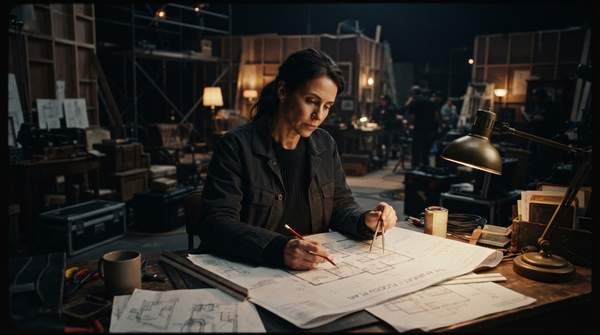
The production designer shapes a film's visual world, but the role is as much managerial as it is artistic. As Loop Talent describes it, the designer works closely with the director and producer to ensure the film's vision aligns with the budget and resources available, while also communicating with departments across the production—including crew members and wardrobe supervisors—to synchronize every visual element on screen.
That synchronization is what makes the position strategically important. The designer is one of the few collaborators whose decisions ripple outward into construction, locations, props, and wardrobe simultaneously. A single choice about where a scene takes place can change what needs to be built, what needs to be rented, and how many crew days the schedule requires. That is why the designer sits at the intersection of creative development and cost planning, rather than at the end of a creative chain.
Pre-Production Workflow: From Script to Set Design
Pre-production is where the art department does its most consequential work. Filmustage's guide to departmental budgeting describes design development and resource planning as the department's main focus during this phase, with designers setting aside money for concept artists, preliminary set designs, and material research. The department's pre-production budget covers set design development, costume planning, and prop acquisition research.
The workflow runs roughly in sequence: the designer reads and visualizes the screenplay, develops concepts and visual references, collaborates with the line producer on a realistic budget, and then works through locations and set design within those constraints. Each stage narrows the range of possible costs. Skipping or compressing a stage doesn't eliminate those costs—it defers them into production, where they are harder to absorb.