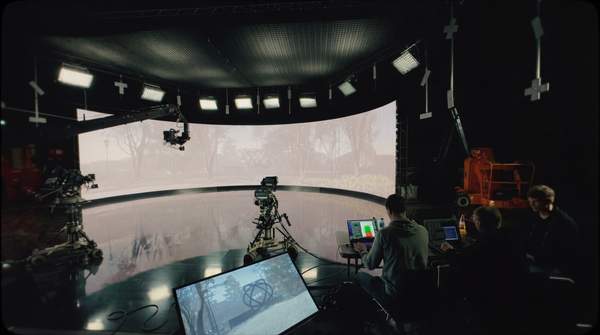
At Tyler Perry Studios, an existing soundstage is being transformed into a virtual production environment with a 15,552px wide LED wall and a ceiling resolution of 7992px x 4104px. This transformation marks a major shift in filmmaking, enabling the studio to integrate advanced real-time digital environments. The partnership with IMDb and Synapse aims to enhance efficiency and creative scope.
Tyler Perry Studios is known for its high-volume, cost-effective production model. However, this investment in complex virtual production technology, specifically the Synapse virtual production soundstage, suggests a deeper commitment to cutting-edge innovation than previously perceived, challenging its established lean approach.
This significant technological investment positions Tyler Perry Studios to attract high-tech productions and solidify its role as an industry innovator, potentially pressuring other studios to accelerate their adoption of virtual production.
Inside the State-of-the-Art Virtual Production Volume
- The LA Volume Stage measures 62 ft. wide, 22 ft. tall, and 40 ft. deep with a 240° FOV (Center), according to SynapseVP.
- Its LED wall is 72 tiles wide (118’ linear) by 13 tiles tall (21.4’), delivering a resolution of 15,552px wide by 2,808px tall.
- The full-resolution ceiling features 7992px x 4104px.
- The LED panels operate with a 2.31mm Pixel Pitch, a 170° Viewing Angle, 1500 nits brightness, and a 7680Hz Refresh Rate. This extreme refresh rate suggests an emphasis on flicker-free, high-speed camera capture for film.
- The system integrates 11 SX40s, 26 XDs, and 11 Nvidia a6000 Render Nodes.
These specifications, including the 2.31mm Pixel Pitch and 11 Nvidia a6000 Render Nodes, prioritize photorealistic quality and complex real-time rendering. This setup aims for cinematic fidelity comparable to traditional on-location shoots, moving beyond basic virtual backgrounds.
Why Tyler Perry's Investment Matters
Tyler Perry Studios is converting an existing stage, according to Deadline, rather than building new facilities. This approach shows strategic agility, allowing rapid integration of advanced virtual production capabilities without typical delays and costs.
Given the detailed Synapse specifications, including the 15,552px wide LED wall and 11 Nvidia a6000 Render Nodes, Tyler Perry Studios is establishing a new industry benchmark for accessible, high-fidelity real-time filmmaking. This move could compel competitors to match its technical prowess or risk falling behind.
The Broader Shift to Virtual Production
The new soundstage at Tyler Perry Studios exemplifies a growing industry-wide shift towards virtual production, driven by its potential for efficiency, creative control, and cost savings. This technology allows for fully immersive, dynamic environments that react in real-time to camera movements and lighting changes, drastically reducing post-production needs compared to traditional green screen methods.
Implications for Filmmaking and Beyond
The new soundstage is poised to attract diverse projects, fostering local talent in virtual production within the Atlanta film industry. This advanced facility could establish Atlanta as a leading hub for advanced filmmaking techniques.
The high-end hardware, including 11 SX40s and 26 XDs, confirms a professional-grade setup. This facility can handle major studio productions, potentially challenging established VFX houses. By Q4 2026, Tyler Perry Studios' Synapse stage will likely reshape production expectations for many independent and major projects filming in the region.
Your Questions About Virtual Production Answered
What is Synapse virtual production?
Synapse virtual production refers to the integrated system of LED walls, real-time game engines, and camera tracking used to create live, immersive digital environments on set. It allows filmmakers to capture final pixel imagery directly in-camera. Synapse provides the hardware and technical integration that enable these complex virtual scenes to be rendered and displayed with high fidelity.
How does virtual production work?
Virtual production combines physical sets with digital backgrounds displayed on large LED screens. A camera tracking system synchronizes the virtual environment's perspective with the physical camera's movement. This allows actors to perform within a dynamic digital scene, with lighting and reflections reacting in real-time.
What are the benefits of virtual production soundstages?
Virtual production soundstages offer significant benefits, including immediate visual feedback for directors, reduced need for costly on-location travel, and greater creative control over environments. They also minimize post-production time and costs associated with traditional green screen VFX. The ability to simulate various environments on a single stage enhances production efficiency.