Dialogue carries the words and music carries the score, but the space between them belongs to sound design's quieter workhorses: Foley, ambient sound and spot sound effects. These elements do distinct jobs — Foley grounds action in physical reality, ambience establishes place and mood, and spot effects punctuate moments and steer attention. This article compares each element across the same three dimensions — narrative function, emotional impact and creative purpose — so filmmakers can choose deliberately rather than by habit. Two further tools, designed sounds and silence, extend the palette where realism itself is not the goal.
Beyond Dialogue and Music: The Core Elements of Sound Design
Sound design, as Abbey Road Institute's Carlos Bricio describes it, is the creative and technical process of capturing, manipulating, layering and integrating audio elements to enhance films, television, games and more — in his words, deciding "how things should sound, where they are or how loud they would be, and make emotions in whoever the listener is." Crucially, much of this work goes unnoticed: writing for SAE UK, Jim Ottewill notes that designed sound establishes atmosphere and tone "often without audience members even realising how hard it's working."
Within that craft, the elements beyond dialogue and music divide naturally by role. Foley recreates the sounds of bodies and objects in motion; ambience builds the sonic bed of a location; spot effects highlight specific actions and events; designed sounds invent audio for things with no real-world reference; and silence, deployed deliberately, reshapes everything around it. Understanding which element answers which creative question is the first step toward an intentional mix.
Foley: The Sounds of Reality
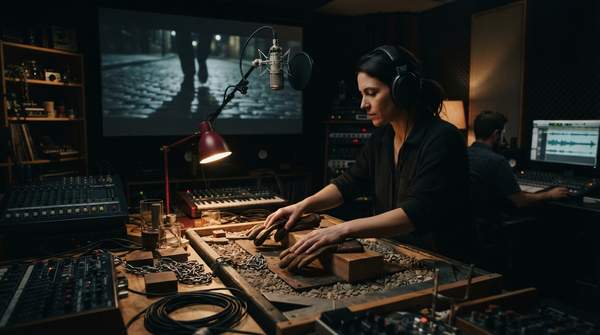
Foley covers the sounds that would be impractical to capture or fabricate through conventional sound effects work. The guide from 344 Audio, an audio post-production company, lists footsteps, cloth movement and gun handling as classic examples — the everyday textures of bodies interacting with the world. Foley artists perform these sounds in sync with the picture, so that a scene's physical detail registers as continuous and real rather than staged.
Emotionally, Foley's contribution is weight. Writing for Dark Horse Institute, Dave Hagen argues that in an action scene it is "the layered sounds of clashing blades, grunting, breathing, heavy impacts, and the scuffling of feet" that draw an audience into the action, not the choreography alone. Foley adds realism and, in his phrase, "infuse[s] scenes with emotional weight and impact, ensuring that audiences are fully immersed in the on-screen events."
Its creative purpose, then, is immersion through specificity: a swordfight feels dangerous because each footfall and cloth rustle is present, matched and believable. BVS Film Productions makes the same point from the audience's side, noting that footsteps, rustling clothes and distant conversations "bring realism and ground the audience in the world the filmmakers have created." When a scene feels physically present but oddly hollow, the missing element is often Foley.