What Are Film Crew Roles and Responsibilities Explained?

Even before a single frame is shot, the 1st Assistant Director meticulously plans the entire filming schedule, ensuring hundreds of specialized tasks align perfectly to bring a director's vision to li

VR
Victor Ren

April 25, 2026 · 5 min read

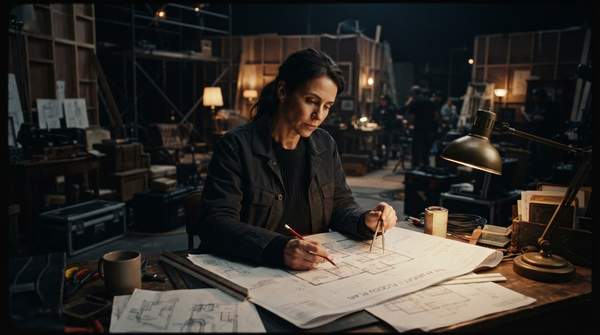
A diverse film crew working together on a set, preparing cameras and lighting equipment in the early morning light.

Even before a single frame is shot, the 1st Assistant Director meticulously plans the entire filming schedule, ensuring hundreds of specialized tasks align perfectly to bring a director's vision to life. This critical role coordinates diverse departments, from camera to art, transforming abstract artistic concepts into a concrete operational blueprint. Such logistical precision is paramount for film crew roles and responsibilities in 2026.

A single director holds the ultimate creative vision for a film, but its realization depends on a vast, specialized crew, each with distinct, perfectly coordinated responsibilities. This inherent tension between singular artistic intent and distributed execution defines the filmmaking process.

A film's success hinges not just on a brilliant director, but on the seamless, often invisible, collaboration of dozens of highly specialized roles. Understanding this intricate ecosystem is crucial for anyone aspiring to work in film.

A film director manages the creative aspects of production, guiding artistic direction from concept to screen, according to Studiobinder. This creative oversight begins in pre-production. Simultaneously, the Executive Producer finances the film and oversees overall production, as stated by Onassemble.

The tension between these roles clarifies that "in charge" has distinct meanings. The Executive Producer maintains financial and overarching managerial control. The director retains day-to-day creative and operational control. This division establishes the foundational hierarchy, differentiating financial oversight from artistic execution.

The Director's Vision and Its Orchestration

The film director holds the final say on a film's tone, executing this vision through consistent communication with every department head, according to Studiobinder. This responsibility extends to refining the narrative, with directors working alongside writers to make necessary script revisions, as reported by Filmskills. Their role is not solitary, but deeply collaborative, guiding the film's entire aesthetic and narrative arc. This constant collaboration ensures the director's nuanced creative decisions translate accurately through multiple layers of specialized expertise, aligning every visual and auditory element with the overarching creative goal.

On-Set Command and Visual Execution

The 1st Assistant Director (1st AD) plans the intricate filming schedule, collaborating with department heads for an efficient shoot. This role includes creating the shooting schedule with producers and crew heads, overseeing the call sheet, and ensuring adherence to timings and positions, according to Onassemble. The perceived glamour of a director's vision is fundamentally underpinned by a logistical architect whose precision prevents artistic ambition from dissolving into chaos.

Concurrently, the Director of Photography (DP) oversees the camera team and the grip and electric department, responsible for all camera and lighting techniques, as noted by Studiobinder. The Key Grip manages all non-electrical gear on set, supervising Grips and ensuring on-set safety. This clear division of labor reveals that a film's creative coherence is not a singular stroke of genius, but the successful integration of hundreds of micro-decisions made by highly specialized, interdependent professionals.

The Precision of Camera and Grip Teams

Within the camera department, the 1st Assistant Camera (1st AC), also known as the Focus Puller, meticulously controls the focus of each shot. This precise technical skill directly impacts a scene's visual clarity and artistic intent, ensuring the director’s intended subject remains sharp. The 2nd Assistant Camera (2nd AC) further supports camera operations, tracking and maintaining gear, building rigs, and operating the clapboard to prevent costly delays.

In lighting and grip, the Best Boy serves as the assistant to either the Gaffer or Key Grip, acting as foreman for their teams, according to Studiobinder. These specialized roles ensure the technical perfection and smooth operation of camera and lighting equipment, crucial for the final cinematic output. This deep hierarchical structure, from the director down to the Best Boy, functions as a robust communication protocol, translating nuanced creative decisions through multiple layers of specialized expertise.

Why Specialized Film Crews Ensure Vision

Intricate coordination among specialized film crew roles ensures a director's singular creative vision translates into a cohesive cinematic product. The director's "final say" is not a singular creative act, but continuous, high-level guidance of a distributed creative system. Specialized roles, like the 1st AC’s focus pulling or the Key Grip’s safety management, directly embody and execute segments of that overarching vision, making the abstract concrete.

This hierarchical delegation and logistical precision are crucial for artistic fidelity. The 1st Assistant Director’s meticulous pre-production scheduling and on-set coordination form the foundational scaffolding, enabling the director’s artistic vision to be physically realized. This prevents creative intent from collapsing under operational chaos. This robust communication protocol ensures nuanced creative decisions translate accurately through multiple layers of specialized expertise, maintaining artistic integrity.

The tension between the Executive Producer being "in charge of the production" and the Director having "final say on the film's tone" suggests that true "control" on a film set is fragmented. Financial oversight remains distinct from, yet reliant upon, artistic execution. Logistical precision often dictates artistic fidelity, ultimately delivering a high-quality, cohesive film to the audience.

What are the main departments on a film set?

Film sets typically organize into several main departments: Production, Camera, Sound, Art, and Post-production. Each department contains specialized film crew roles, ensuring every aspect of filmmaking is covered from conceptualization to final edit. This structure facilitates efficient workflow and communication across the complex production process.

What is the role of a director of photography?

A Director of Photography (DP) is responsible for a film's overall visual aesthetic, translating the director's vision into tangible imagery. Beyond overseeing camera and lighting, the DP collaborates closely with costume and production design to ensure visual consistency. They make critical decisions on framing, camera movement, and shot composition to capture the desired mood.

What does a gaffer do on a film set?

The Gaffer serves as the head electrician on a film set, implementing the lighting plan designed by the Director of Photography. This role involves managing all electrical equipment, including lights, cables, and generators, to achieve the desired mood and visual effect for each scene. The Gaffer's team ensures proper power distribution and safety protocols are maintained throughout the shoot.

By 2026, continued advancements in production management software, such as those highlighted by Onassemble, will likely further refine the orchestration of these specialized tasks, making efficient coordination even more critical for cinematic success.