A script supervisor is the crew member responsible for making sure a film shot out of sequence can still be cut together as a coherent story. They track dialogue, actor movements, props, wardrobe, and camera details on set, compile those records into a "production book," and hand the editor a comprehensive guide for assembling the final cut. As Toronto Film School's Garry Murdock explains, because most productions are shot out of sequence, "missing even a small detail is enough to ruin a scene" — and by post-production, it is too late to fix the problem. The role spans three phases, and each phase builds directly on the last.
The Critical Role of a Script Supervisor in Film and TV Production
Films are rarely shot in story order. As REEL CANADA, an organization promoting Canadian film, describes it, shooting is organized according to the practicalities of location and cast availability rather than the unfolding of the story. The classic result is the continuity error: an actor's glass of juice is empty in one shot and full again in the next. The script supervisor's job is to ensure those errors — and many other continuity issues — do not happen, and to help organize footage for the editor, who is usually not on set during filming.
The stakes are practical, not aesthetic only. Andrea Fantauzzi, who has worked as both a script supervisor and an editor, puts the consequence plainly: "If the continuity is off, you are forcing the editor to make cuts that can affect the quality of the film." She gives the example of an actor wearing reading glasses in a wide shot whose glasses are missing in a later mid-shot or close-up; from the editing side, she says, that mismatch "severely limits your usable shots." In other words, a continuity slip does not just look like a mistake on screen — it removes options from the edit and can compromise the finished film.
Pre-Production: Laying the Groundwork for Continuity
The work starts well before cameras roll. During pre-production, the script supervisor prepares a continuity breakdown, a document that analyzes the script in terms of cast, actions, wardrobe, and props across scenes and story days. This breakdown is the foundation for everything that follows: it tells the supervisor what details must be matched before the shoot begins, rather than discovered as problems during it.
The supervisor then times the script — estimating how long the written scenes will run on screen — which REEL CAANDA's career guide notes is "quite a skill in itself." Timing matters because it informs planning and scheduling: it signals whether scenes can be trimmed, where coverage is needed, and how the day's shooting will fit together. Pre-production is also when the supervisor becomes fluent in the script's structure of story days and scene order, since filming will jump around that structure for weeks. Without this preparation, on-set monitoring would have no baseline to check against.
On-Set: The Continuity Guardian During Production
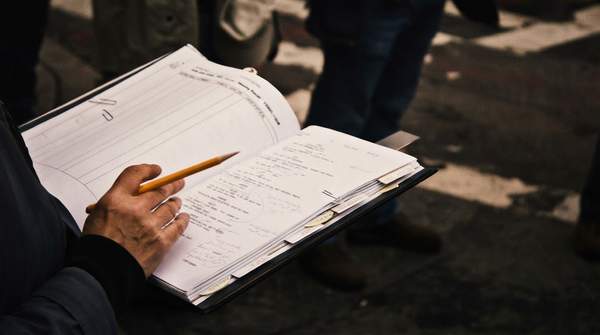
Once filming starts, the script supervisor closely monitors what is happening on set, checking that no dialogue is overlooked and that the actions and eye-lines of the actors match from shot to shot. Grand Canyon University's program guide describes the level of detail involved: extensive notes about each scene record which direction an actor looks while speaking a particular line, which hand an actor uses to pick up a prop, and so on.
The records go beyond performance. The supervisor keeps detailed written and photographic records of dialogue, action, costumes, and props, and notes all camera and lens details along with slate and scene number information — including, according to GCU, information about lenses and filters. Scene and take numbers are referenced throughout, so every usable piece of footage can later be located and compared. The supervisor also keeps a progress report of each day's filming, which goes to production and, for VFX shots, to the Visual Effects Supervisor. These daily records are, in REEL CANADA's words, "invaluable," because they capture information in real time that no one else on set is systematically tracking.
Post-Production: Enabling the Editor's Workflow
After all the scenes have been shot, the script supervisor organizes and compiles all of the scene notes into a production book. This is the role's central deliverable: the director, editors, and visual effects artists refer to the production book to ensure continuity during the post-production phase. For an editor facing weeks of footage from scenes shot days or weeks apart, often out of order, the book answers the questions that determine which cuts are possible: which take matched the eyeline, which hand held the prop, which lens was on the camera.
This is where the role's earlier phases pay off. The continuity breakdown identified what to watch; the on-set notes captured what actually happened; the production book turns that raw record into a usable reference. Without it, editors would have to reconstruct continuity by trial and error — or, as Fantauzzi's editing experience shows, simply lose shots they cannot match. The production book's value lies precisely in its comprehensive detail, which lets editors piece together scenes shot weeks apart seamlessly, avoiding errors that would otherwise affect the film's budget and credibility.
Script Supervisor Workflow: From Script to Screen
The timeline below traces how the script supervisor's tasks flow from one production phase into the next, mapping each phase's work to its output and to who depends on it downstream. Read it left to right to see how early preparation enables on-set monitoring, and how on-set records become the editor's guide.
| Production Phase | Key Tasks | Primary Output/Deliverable | Impact On |
|---|---|---|---|
| Pre-Production | Prepare a continuity breakdown analyzing the script by cast, actions, wardrobe, and props; time the script | Continuity breakdown; script timing | Planning, scheduling, and the baseline for all on-set monitoring |
| Production (On-Set) | Monitor dialogue, actor actions, and eye-lines; keep written and photographic records of dialogue, action, costumes, and props; note camera, lens, slate, and scene/take details | Daily written and photographic records; progress reports | Visual and narrative consistency across shots; production office and VFX Supervisor |
| Post-Production | Organize and compile all scene notes | Production book | Director, editors, and visual effects artists assembling the final cut |
The sequence matters: each row supplies the raw material for the next. The breakdown from pre-production tells the supervisor what to track on set; the on-set records give the production book its content; and the production book is what allows the editor — who was never on set — to match shots that may have been filmed weeks apart.
The Skills Behind the Notes
The role demands a specific combination of competencies. Attention to detail and rigorous organization are non-negotiable, since the records must capture details as fine as which hand picked up a prop. The supervisor also needs a working understanding of how films are made — composition, blocking, and above all editing — because judging whether shots will cut together requires thinking like the person who will assemble them. On a working set, communication and diplomacy matter too: the supervisor must flag a continuity problem to a director or actor in the moment, without stalling production. Timing a script accurately, as the pre-production phase requires, is itself a developed skill rather than a clerical task.
The Indispensable Link: Why Script Supervisors Are Essential
Recognize the script supervisor as a critical, proactive role that ensures narrative coherence and production efficiency, directly impacting the quality and cost-effectiveness of the final film. The role is essential precisely because filming is out of sequence: the supervisor's detailed notes are the primary reference for assembling a coherent final product, and the production book they compile is the definitive guide that lets the editor work without guessing. The measurable indicator of effective script supervision is a final cut free of continuity errors, delivered on schedule and within budget — the concrete outcome that distinguishes a film that was properly supervised from one whose editor was forced to cut around avoidable mistakes.
Sources
- What Is the Role of a Script Supervisor — Toronto Film School
- Script Supervisor - REEL CANADA
- What Is a Script Supervisor? — GCU