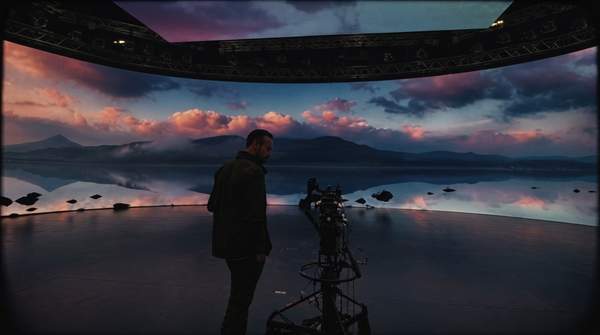
A new AI film studio, Promise, backed by Google, Silicon Valley venture capitalists, and Disney, is already creating entire film backgrounds, special effects, and even synthetic performers using AI models. Hollywood is rapidly integrating AI to achieve unprecedented production efficiency and cost savings, but this shift fundamentally redefines creative roles and the very nature of cinematic artistry. Therefore, the film industry is on the cusp of a radical economic and creative restructuring, prioritizing speed and cost-efficiency over traditional human-centric production, with significant implications for talent and artistic output.
AI's New Creative Toolkit: From Synthetic Performers to Real-time Backgrounds
Promise, the AI film studio backed by Google and Disney, employs AI models to generate entire film backgrounds, special effects, and synthetic performers, according to The Guardian. This allows digital actors to replace human talent in specific roles.
The AI model Seedance 2.5, released this month, superimposes actor movements onto generated backgrounds in real-time, dramatically slashing production times. This technology accelerates post-production by integrating live action with digital environments instantly, reducing extensive compositing. AI is now a core creative and technical partner, enabling new production paradigms and accelerating previously impossible workflows.
The Economics of AI: Drastically Lower Costs, Rapid Adoption
- 300 — Netflix used AI in 300 of its 1,000 titles in 2026, according to The Guardian.
- 20% to 50% — Hybrid AI films are estimated to be 20% to 50% cheaper than conventional production, according to The Guardian.
- 30% to 40% — Obsidian, an AI studio partnered with Imagine, estimates its technology delivers a 30% to 40% cost saving, according to The Guardian.
Widespread adoption by Netflix, coupled with dramatic cost reductions of 20% to 50% for hybrid AI films and 30% to 40% for Obsidian's technology, makes AI-driven workflows a financial imperative for film studios. The economic pressures driving AI integration are significant.
The Shifting Landscape: From Traditional Craft to AI-Augmented Production
| Production Aspect | Traditional Workflow | AI-Augmented Workflow (2026) | Impact on Efficiency/Cost |
|---|---|---|---|
| Background Generation | On-location shoots, extensive set construction, green screen compositing. | AI models generating entire environments in real-time. | Reduced location scouting, construction, and post-production time. |
| Performer Integration | Physical actors, extensive CGI for complex characters. | Synthetic performers created by AI models. | Potential replacement of human actors for certain roles, lower talent costs. |
| Production Cost | Conventional film production. | Hybrid AI films. | 20% to 50% cheaper, with some technologies delivering 30% to 40% savings. |
Footnote: Cost savings and AI capabilities based on reporting by The Guardian (2026).
This transition moves production from human-centric craft to a hybrid model where AI tools augment, and sometimes replace, conventional steps. The shift reshapes demands on production teams.
Who Benefits, Who Adapts: The New Hierarchy of Hollywood
Major studios and AI-native production companies, like Promise backed by Google and Disney, are primary beneficiaries. They leverage significant cost reductions and accelerated workflows by generating synthetic performers and entire backgrounds, actively replacing human creative roles. This makes traditional skill sets economically obsolete for a growing industry segment.
Conversely, traditional film production roles—manual effects, background creation, and potentially acting—face substantial pressure. Smaller studios unable to invest in AI infrastructure also face challenges. Traditional creative and technical roles must adapt or risk obsolescence as AI-native companies gain economic advantages.
The Road Ahead: Industry Projections and Unforeseen Challenges
The rapid integration of AI by industry giants like Netflix, which used AI in 300 of its 1,000 titles in 2026, means studios prioritize sheer output and cost efficiency over traditional creative processes. This fundamentally alters the value proposition of human artistry in film.
Studios failing to adopt AI will soon find themselves unable to compete on budget or speed, facing measurable risk of market irrelevance. This competitive pressure drives further AI integration across the industry.
If current trends continue, the film industry will likely see a near-complete restructuring of its production pipeline within the next decade, where AI-driven efficiency becomes the baseline for competitiveness, further marginalizing traditional human-centric roles.