The authors who get the most from book fairs treat them as campaigns rather than single-day stalls. Advice from experienced event-goers converges on a clear pattern: pick one primary goal before you commit, prepare a simple table that makes buying effortless, engage readers with personalization rather than pressure, use the fair for industry networking as well as sales, and follow up afterward so the effort compounds. Writing coach Peter Mountford, who has presented at events including the Miami Book Fair, the Boston and Brooklyn Book Festivals, describes these gatherings as among the most strategic places a writer can spend time precisely because hundreds of authors, publishers, and readers gather in one room. Here is how to work that room.
Setting Your Book Fair Goals
The single most consequential decision happens before you pack a single box. Book marketing guidance for tabling authors is blunt on this point: you can sell, build discovery, and network all in one day, but you will do all three better if one is the main focus. The goal you choose changes what you carry and how you spend your hours on the floor.
Each goal implies a different kit. If your goal is sales, you bring more inventory and push bundles. If it is discovery, you prioritize a clear hook, a strong freebie, and a smooth email signup. If it is networking, you bring sell sheets and business cards, and you deliberately leave time to walk the room. A defined goal also gives you something to measure afterward: books sold, subscribers gained, or meaningful industry contacts made. Without that anchor, a fair can feel busy and still produce nothing durable.
Pre-Fair Preparation: The Essential Checklist
Preparation divides into strategy and materials. On the strategy side, write and rehearse a one-sentence pitch for your book, decide which title serves as your "starter book" if you have several, and choose a simple menu of things to sell. Experienced tablers advise keeping that menu small and clear: most author tables work best when they offer a compact, obvious set of options, and a designated starter book makes the choice easy for a hesitant browser.
On the materials side, plan a readable, visually appealing table; prepare an email signup mechanism with an incentive ready; and pack the small items that make transactions smooth. Practitioner advice emphasizes two easily forgotten details: bags, because people buy more when they can carry books easily—and even simple paper bags with a sticker or stamp feel polished—and whatever you need to personalize copies on request. Publicizing your appearance on social media ahead of the event rounds out the pre-fair phase, so attendees arrive already looking for your table.
Engaging Readers at Your Table
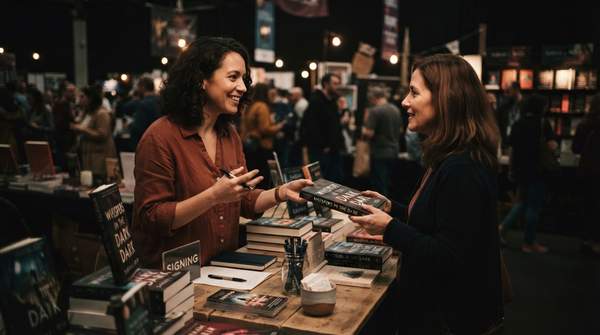
At the table, the aim is low-pressure conversion: turn a browsing stranger into a buyer or subscriber without making either of you uncomfortable. The techniques that recur in author accounts are small and concrete. Invite people to pick the book up—physical interaction does sales work a pitch cannot. Personalize when someone buys: signing a copy turns the purchase into a keepsake, which practitioners report as a genuine sales boost rather than a gimmick.
For list growth, face-to-face contact is your advantage, but the ask has to earn its own yes. Simply requesting that someone "join my newsletter" is rarely compelling on its own, so give a reason that feels immediate: a free short story, a bonus epilogue, a first-chapter sampler, a printable reading checklist, or entry into a small giveaway. Marketing guidance from BadRedhead Media suggests a giveaway of a small gift card emailed to one lucky subscriber as one tested format. The common thread is that the incentive is tangible at the moment of signup, not a vague promise of future emails.
Beyond Sales: Strategic Networking
A fair full of authors, publishers, and organizers is a career opportunity that exists for one day only. Mountford's account of speaking at the Miami Book Fair—an eight-day November event drawing hundreds of authors and publishers—illustrates the scale of connection available even to emerging writers who attend with intent. Networking at fairs, as described by authors who tabulate these benefits, includes meeting and chatting with readers face-to-face in ways that can lead to new readers, future events, and unexpected opportunities.
Operationally, networking means leaving your own table. Bring sell sheets and business cards so a conversation with a bookstore owner or event organizer can turn into a follow-up, and block out time to walk the room while your display mind itself. Two complementary tactics reduce cost and increase contact: sharing a stand with another author splits the table fee, builds camaraderie, and creates a natural ally who will point her readers toward your books, and scheduling meetings around the fair dates—coffee with an editor or a bookseller who is already in town—captures value a one-day sales mindset misses. Supporting the literary community genuinely matters too; authors who participate report feeling energized by events that celebrate reading and promote literacy, and that energy is visible to the people you want to work with.
Post-Fair Follow-Up for Lasting Impact
The fair ends; the value does not. Following up like a professional is what converts a day of interest into durable assets. Email your new subscribers promptly—ideally delivering the freebie or giveaway result you promised, which establishes trust before your first real newsletter arrives. Reach out individually to industry contacts with a short, specific note referencing your conversation, whether that contact is a fellow author, a bookstore owner, or an organizer who might book you for a future event.
Author-preparedness guidance frames the payoff in compounding terms: your next fair becomes easier because you are no longer guessing. Prep with clarity, keep the table readable, make buying effortless, and follow up like a professional, and book fairs stop feeling like a gamble. They become, in that framing, a repeatable way to sell, connect, and grow your author presence in the real world. Review your numbers against the goal you set before the event, and carry what worked into the next fair's planning.
Your Comprehensive Book Fair Preparation Checklist
This checklist organizes the advice above into a chronological sequence you can reuse for any event, moving from high-level strategy through on-the-ground execution to post-event follow-up.
| Phase | Strategy | Key Action | Purpose |
|---|---|---|---|
| Pre-Fair Planning | Goal setting | Set one primary goal: sales, discovery, or networking | Focuses preparation and gives you a measurable success criterion |
| Pre-Fair Planning | Materials preparation | Build a readable table display, choose a simple product menu with a starter book, prepare signup materials and networking collateral | A well-prepared table attracts attention and makes engagement and transactions smooth |
| At-the-Fair Execution | Reader engagement | Invite browsers to handle the book, personalize conversations and signed copies | Low-pressure, personalized interaction converts browsers into buyers and builds rapport |
| At-the-Fair Execution | Email list growth | Offer an immediate incentive: free short story, bonus epilogue, sampler, printable checklist, or giveaway entry | A tangible reason to sign up increases conversion and enables continued engagement |
| At-the-Fair Execution | Networking | Walk the room with sell sheets and business cards; consider sharing a stand to split costs | Extends the fair's value beyond immediate sales toward collaborations and future events |
| Post-Fair Follow-Up | Sustaining connections | Email new subscribers and follow up personally with industry contacts | Timely follow-up converts initial interest and connections into lasting benefits |
Work the table top to bottom for each event: define the goal, assemble the materials, then execute and follow through. Because each row ties an action to a purpose, you can also diagnose failures—if signups lag, the incentive row is where to look; if sales lag, examine the menu and the buying experience.
Maximize Your Next Book Fair: A Strategic Approach
Authors should adopt a structured, goal-oriented approach to book fairs, focusing on pre-event preparation, active engagement, and strategic networking to achieve measurable outcomes. The evidence for this structure is consistent across independent author accounts: preparation with clarity, a readable table, effortless buying, and professional follow-up are what separate a repeatable growth channel from a one-day gamble. The measurable indicator is concrete: after implementing the strategies, look for increased book sales, growth in email list subscribers, and new industry connections—follow-up emails sent and received, and collaboration inquiries—attributable to the event. Set your goal, work the checklist, count the results, and repeat.
Sources
- Why Aspiring Writers Should Attend Book Festivals — Peter Mountford Writing Coach
- Book Fairs for Authors: What to Bring, What to Sell, and How to Make Your Table Work — BooksShelf
- Author Fairs: The Hidden Benefits Beyond Book Sales — Badredheadmediallc